
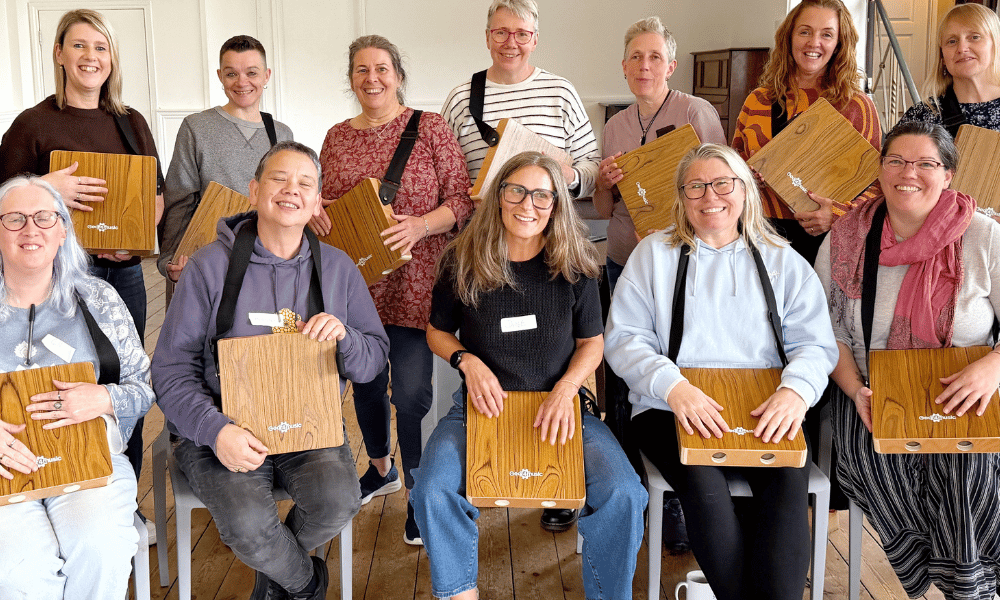
Where, in today’s world, is it acceptable for women to be noisy, to take up space, to self-organise?
Women are conditioned to be agreeable, pleasant, compliant and non-threatening.
It’s only when you stop to think about how unusual it is for women to be loud, to take up space, to self-organise, that you realise this breaches an unwritten social rule. Just think how women’s volume and voice is policed through language; phrases like “shrill”, “screeching”, “gobby” or “too much” are almost never used of men.
Women who drum are claiming power, challenging societal norms, making a statement. It’s positively rebellious. And it’s great for our wellbeing, too!
A bit like the stereotype that women can’t be funny (how many truly successful female comedians can you think of?), drumming is generally seen as a ‘male’ activity. There are very few female professional drummers, and women tend not to see it as a viable hobby. Brilliant female drummers aren’t celebrated; did you know that Karen Carpenter was a talented drummer? Despite considering herself a drummer who sang, she’s remembered for her beautiful singing voice. Perhaps her drumming talent has been erased from history because it doesn’t fit with what’s expected of women? To see her in action, there’s a video of her drumming in the links below.
Somewhere along the way, it was decided that women with drums were dangerous, heretic, even witches
In ‘The Beat of Your Own Drum’, Sophie Messager argues that female drummers disrupt the patriarchy by reclaiming something that’s been deliberately taken from women for centuries. That historically, women drummed together to celebrate, heal, mark important life transitions and grieve. Despite the fact that the first rhythm we hear is our mother’s heartbeat in the womb, we’re disconnected from our historic drumming traditions.
Drumming in a group of women is a particularly profound experience. The first time I stood in a circle of women to drum, I was blown away by the connection, the community, the noise, the collective power, feminine energy and sheer joy of it all. Our group is a collective, a sisterhood, a tribe; transcending age, social class and status, we’re bonded through our love of drumming. Drumming adds visibility, presence and urgency to parades and marches; doing so in a group of marching women adds an extra layer of defiance that’s impossible to ignore.
Drumming is cathartic, and boy, don’t us women need that
Typically expected to be superhuman, women often juggle busy careers, caring responsibilities and heavy mental loads, all while at the mercy of our hormones. I’ve written about the wellbeing and burnout-busting benefits of drumming in previous blogs (links below), but there are some particular benefits for women:
- It’s empowering: women rarely get to hit or strike things, doing so is a reminder of our own strength and can help body positivity
- Rhythm is regulating: women’s frazzled nervous systems and busy minds are calmed by steady rhythms, providing respite from everyday stresses
- A communal activity, it strengthens female bonds and connections
- It’s healing and cathartic: we can express our emotions physically, without having to explain or justify ourselves
- It can help menopausal women: at a life stage that can bring anxiety, brain fog and a sense of becoming invisible, drumming offers regulation, community and a chance to be heard (see Anne’s previous blog about her menopause experience)
- It can help neurodivergent women: Rhythm offers sensory input, a socially acceptable form of stimming, helps impulse control and improves focus, while group drumming creates connection without small talk
Imposter syndrome strikes again
With women particularly susceptible to imposter syndrome, I understand the reticence to see ourselves as drummers or even try it. There’s also a perception that ‘proper drumming’ is playing a full drum kit, which involves specialist tuition, hours of practice, getting to grips with multiple bits of kit and the ability to make all four limbs do different things. Let’s face it, few women have the time, money, space or mental capacity for all that, nor the desire to upset their neighbours with the volume of a full drum kit!
Despite my own love of marching down the local high street banging loudly, I understand that’s not something all women might enjoy. There are gentler ways to drum. You can try drum circles or workshops or simply play a drum at home. I relax by playing the cajon, a wooden box drum that you sit on and play with your hands; it’s easy to play and straightforward to learn. I’d also love to try a frame drum at some point. In our Burnout Beaters sessions, we use small travel cajons, which are light and accessible.
I think attitudes towards drumming are a bit like attitudes towards running. Some people think that you can only call yourself a runner if you run fast or run long distances, which is, of course, rubbish. It’s such a macho attitude. If you regularly run, you’re a runner. It’s the same with drumming: if you regularly drum, you’re a drummer. I may not be trained, or able to play to a high standard, but because I hit drums regularly I am a drummer.
If you’ve always fancied having a go at drumming, I urge you to try it. Make a noise, take up space, lose yourself in the rhythm. Become a drummer, you won’t regret it.
Links:
- Karen Carpenter playing drums: Carpenters – Karen Carpenter Drums – 1968,1976 (Live)
- The Beat of Your Own Drum (Sophie Messager): https://sophiemessager.com/product/the-beat-of-your-own-drum/
- Ten reasons why drumming helps wellbeing: https://burnoutbeaters.org.uk/2026/08/06/ten-reasons-why-drumming-helps-wellbeing/
- Menopause: how drumming helped me: https://burnoutbeaters.org.uk/2026/08/11/menopause-how-drumming-helped-me/
- How drumming can help burnout: https://burnoutbeaters.org.uk/2026/08/26/how-drumming-can-help-burnout/
Leave a Reply